


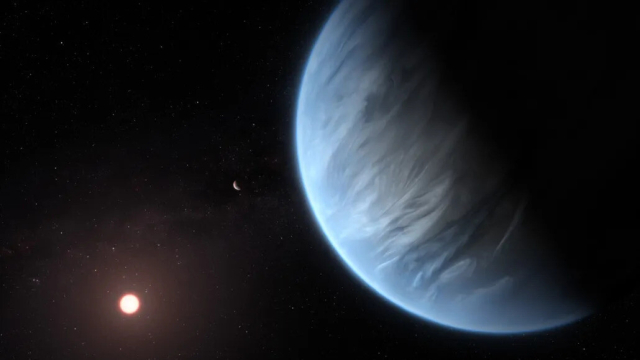
Պատկերը՝ HUBBLE/ESA, M. KORNMESSER
Some planets might produce their own water. In laboratory experiments, researchers simulated extreme conditions found within certain exoplanets by blasting olivine — a mineral abundant in planetary interiors — with high-energy lasers in the presence of hydrogen gas. Hydrogen strips the minerals of their oxygen atoms, which then react with the hydrogen to form water.
The discovery offers a viable explanation for water-rich exoplanets orbiting close to their host stars. The process might even account for the origin of some of Earth’s water, adding a new piece to a longstanding mystery.
Hundreds of exoplanets with sizes and masses between earth and Neptune have been discovered, many of which orbit far closer to their stars than Earth orbits the sun. Their estimated densities suggest they possess rocky interiors covered by a thick layer of water or hydrogen.
However, it’s unclear how these planets could be so water-rich. In the solar system, there’s a clear divide between planets formed on either side of the “snow line.” Inside that line, water is scarce, vaporized by the sun. Venus is an example. Planets formed outside the snow line, like Saturn and Neptune, are rich in water and gas.
Astrophysicists had thought that watery exoplanets must form far from their star and then move inward. The new study suggests that under the right conditions chemical reactions between hydrogen and minerals can produce water locally.
Re-creating those conditions in the lab has been challenging. To achieve the required temperature and pressure, researchers place samples in a tiny container called a diamond anvil cell. But heated hydrogen molecules can get into the diamond’s carbon-atom lattice, causing it to shatter.
By using pulsed lasers instead of a continuous beam — heating the sample for a fraction of a second at a time — researchers reduced the hydrogen infiltration. When the experiment finally worked, the scientists were shocked by the amount of water produced. In the experiments, about 18 percent of the initial mass was turned into water.
The researchers think this water-generating process can occur at the boundary between the planet’s rocky interior and its gaseous hydrogen envelope, where high pressures and temperatures can drive the reaction. The final water content of these planets could range from about 5 percent to 28 percent of the planet’s mass, they estimate.
Source: Nature
Image: Hubble/ESA, M. Kornmesser