


Image: Jim West/UCG/Universal Images Group/Getty Images
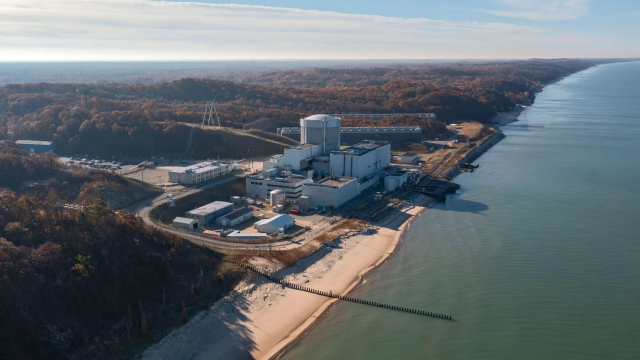
The Palisades nuclear plant, about a two-hour drive from Chicago, was decommissioned in 2022, judged to be uneconomical in a world of cheap American gas. But Florida-headquartered company Holtec is reviving it. It will mark not only the first ever restart of a shuttered US nuclear plant, but, if all goes to plan, Palisades will also be the birthplace of a nuclear breakthrough: America’s first commercial “small modular reactors.”
These advanced nuclear reactors, known as SMRs, are like mini nuclear power plants but touted as cheaper, safer, faster to build and easier to finance than their conventional counterparts — and hype around them is rising fast.
Their appeal is clear: the prospect of abundant, clean power that can run 24/7. They’re catnip for tech companies seeking reliable energy sources to slake the incredible thirst of their data centers, expected to increase exponentially as AI grows.
SMRs are in a sweet spot right now, said Michael Craig, an associate professor of energy systems and climate at the University of Michigan. “They’re in this perfect ground where there’s lots of great ideas … and they have a lot of promise and potential.”
The enduring appeal of SMRs is found in their name. First, it’s about size. Large conventional nuclear reactors are incredibly expensive, sometimes stretching to tens of billions of dollars. Smaller reactors simply cost less to build. They are a technological solution to a financial problem.
It’s also about modularity. The idea is these small reactors will be mass produced in centralized factories and delivered to sites, making them cheaper and more flexible than huge nuclear plants.
Holtec wants to prove the concept at Palisades in Covert Township, Michigan. Alongside firing up the 800-megawatt conventional reactor, the company plans to install two 300-megawatt SMRs to be built in its Camden, New Jersey, factory.
The company kicked off the formal licensing process with the Nuclear Regulatory Commission last month and hopes to have everything approved by 2029, with the SMRs coming online by 2031, a Holtec spokesperson said.
Its long-term aim, with partner company Hyundai Engineering & Construction, is to build a fleet of SMRs in North America in the 2030s.
Source: CNN