


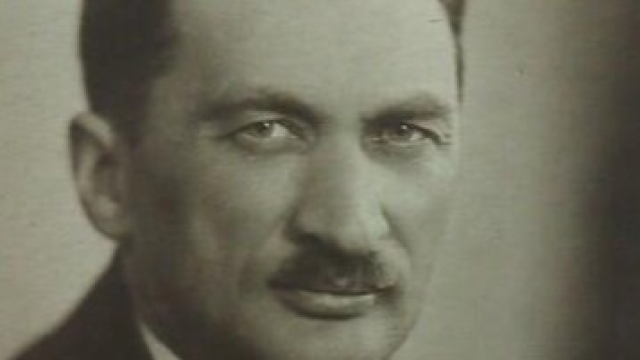
Image: Nikolay Gundobin
On May 6, 1927, the Council of Labor and Defense of the USSR issued a decree authorizing the construction of the Dzoraget (Kоlageran) regional power plant. The decree recognized the need for a hydroelectric plant on the Dzoraget river in the Armenian SSR, which was marked as "Kamenka" on pre-revolutionary Russian maps.
The proposed facility, with a capacity of 21 MW, was intended to supply power to the industrial regions of Northern Armenia and a cyanamide plant, along with the necessary transmission lines for energy distribution.
The group of engineers involved in the construction of the hydroelectric power plant included several notable figures, among them architect and civil engineer Nikolai Gundobin. Gundobin, one of the builders of the Volkhov and Dnieper hydroelectric power plants, was a key member of the team.
Nikolai Petrovich was born in 1893 in the city of Murom, Vladimir Province. His father, Pyotr Vasilievich Gundobin, was a hereditary honorary citizen of Murom. In the early 1900s, the family relocated to St. Petersburg.
Nikolai Gundobin was a graduate of the Institute of Civil Engineers. From 1920 to 1924, he also studied at the Petrograd State Free Art and Technical Workshops of the All-Russian Academy of Arts, where he attended the architectural department (the Higher Art and Technical Institute, formerly the Imperial Academy of Arts).
During these years, Nikolai Petrovich participated in the design and construction of the Volkhov hydroelectric power plant as both an architect and civil engineer, working as part of a team led by Oscar Muntz. He also played a key role in the design and construction of four other hydroelectric power plants, including the DzoraHPP, which was considered unique for its time.
Gundobins treasured a family heirloom – a centuries-old icon depicting St. Nicholas the Wonderworker, which had belonged to his mother, Glafira Alekseevna. For many years, the icon was kept hidden away in a linen closet. One family story is particularly notable: when Glafira Alekseevna was pregnant, she dreamed of St. Nicholas.
Her vision was so vivid that Glafira Alekseevna took it as an omen. She named her son Nikolai and commissioned a protective icon of St. Nicholas the Wonderworker specifically for him. The icon was painted in 1893 in St. Petersburg by icon painter P. I. Brusnikin.
The descendants of Nikolay Gundobin believe that Nikolai Petrovich died in besieged Leningrad in 1942, yet the cross in the family plot at Smolensk Lutheran Cemetery in St. Petersburg displays the year of his death as 1945.
It is likely that Nikolay Petrovich Gundobin was evacuated from Leningrad, where he was later able to return. In March 1944, he participated in a Scientific and Technical Conference held in Gatchina. A transcript of his speech, which focused on the restoration of heritage in Pavlovsk and Pushkin, has even been preserved.
Source: ECTI
Image: Nikolay Gundobin