


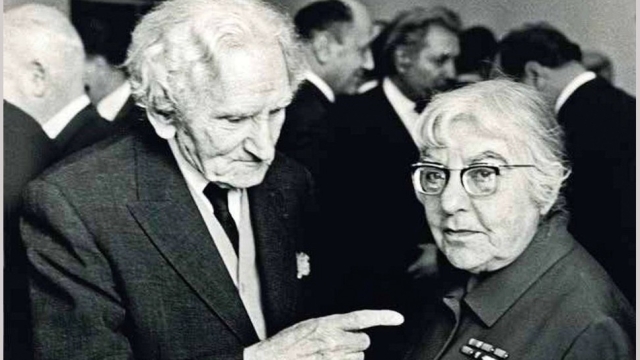
Image: Martiros Saryan and Marieta Shaginyan, 1965
The world-renowned Armenian painter Martiros Saryan was born in the city of New Nakhichevan, the heart of the Armenian colony on the Don River. Armenians have lived in the region since the late 18th century, having migrated from Crimea.
It was in this city, which became one of the centers of Armenian culture, that Martiros Saryan met with Marietta Shaginyan. From 1915 to 1922 well-known by that time poetess and writer lived in New Nakhichevan, where her grandfather and mother lived, and worked in the Azov Region magazine.
The friendship of M. Saryan with M. Shaginyan was long and creatively fruitful. The writer left us two heartfelt articles about Saryan, and the Master created a number of beautiful watercolors for her book “Armenia”.
At the insistence of Marieta Shahinyan, Saryan goes to the construction site of the DzoraHPP, where he creates his paintings reflecting the heroic construction of this unique hydroelectric power plant. From here he takes many sketches in which he learns to depict manifestations of the new life.
Here we come to what can be called Saryan’s personal mystery and what interests his professional critics so much: did he stop in his development, did he go backwards, did that Saryan, whose precious canvases could decorate the treasury of any European Pinakothek ‘die’ – Saryan of 1910 -1913? But the ‘living’ Saryan seemed to answer my involuntary thought with his confident, quiet voice:
“Can you understand, my skill remains with me, and it wouldn’t cost me anything to paint and repeat myself again and again, to make such big and small ‘Saryans’. But why to do what has already been done, repeat it? Now it’s important to find something new.”
As we can see, Marieta Shaginyan uncovered the direction of Saryan’s creative approach through lively, direct conversations with him. What’s striking is that, despite the new themes, the Master depicted them all in his distinct, vibrant style, marked by his characteristic generalization and the use of pure, fresh colors.
However, the transition to socialist realist canons never occurred. As a result, the painter faced harsh criticism, accused of harboring idealistic thinking, labeled an 'anti-people formalist,' and even threatened with being 'strangled with a ruble.'
A more extensive article by Marieta Shaginyan entitled “The Secret of Martiros Saryan” was published during the the Khrushchev Thaw in 1965, when there was already a reassessment of the significance of the Master’s work. A writer who knew Saryan closely noted an important trait of his character. Having listed how much pain and resentment the painter had to endure during the period of the Great Purge, she writes the following phrase:
“Sarian has never been the kind of fighter who throws back an unfair accusation, strikes it with all the weapons of self-defense available to him, parries blow or inflicts them in turn. Those who knew Saryan all his life... deeply understand the quality of this extraordinary person – silence.”
Source: ECTI